Cloud Integration: The Complete Guide to Connecting and Optimizing Your Digital Ecosystem
In today’s online business landscape, companies increasingly rely on a growing number of cloud applications to run operations, serve customers, and drive innovation. While these tools offer outstanding flexibility and scalability, they often operate in silos-creating challenges with data flow, operational efficiency, and clarity. That’s where cloud integration comes in.
Cloud integration is the process of connecting different cloud-based applications, platforms, and on-premises systems to work as a connected ecosystem. Whether you’re an enterprise IT leader or a SaaS startup scaling fast, understanding and implementing effective cloud integration is essential for long-term success.
This guide explores what cloud integration is, why it matters, the tools and platforms that enable it, and best practices for implementation.
What Is Cloud Integration?
Cloud integration refers to the set of processes and tools used to connect cloud-based systems with each other or with on-premises systems to enable easy data sharing and workflow automation.
It typically includes the integration of:
- – SaaS applications (e.g., CRM, ERP, marketing automation)
- – Cloud infrastructure (e.g., AWS, Azure, Google Cloud)
- – Databases and storage systems
- – On-premise systems or legacy applications
Therefore, the goal is to make sure real-time data consistency, unified operations, and improved collaboration across departments.
Why Cloud Integration Matters
Without integration, businesses often struggle with inefficiencies and missed opportunities. One of the major issues is data silos, where valuable information is isolated within individual systems, making cross-functional collaboration difficult. Additionally, For example, manual processes can bog down productivity, as employees must spend considerable time transferring data between systems.
Another challenge is inconsistent reporting, which results from discrepancies in datasets across platforms. This can significantly hinder data-driven decision-making. Moreover, a poor customer experience may arise when disconnected systems lead to fragmented interactions, miscommunications, or delays in service.
On the other hand, effective cloud integration offers several benefits. For example, streamlined operations are achieved through automation, reducing redundancy and human error. Data accuracy improves as systems sync in real-time, ensuring consistent and reliable information.
Moreover, cloud integration enables scalability, allowing systems to grow and adapt with your business needs. It also enhances agility, empowering teams to deploy new services quickly and respond to market changes with greater flexibility.
In conclusion, effective cloud integration offers several benefits:
- – Streamlined operations: Automated workflows reduce redundancies.
- – Data accuracy: Real-time syncing ensures consistency.
- – Scalability: Integrated systems adapt faster to changing business needs.
- -Enhanced agility: Quicker deployment of new services and technologies.
Types of Cloud Integration
There are several approaches to integrating cloud systems, depending on your architecture and business goals:
1. Data Integration
Connects and orchestrates business processes data across systems so that users can access consistent and up-to-date information from any platform.
2. Application Integration
Enables different applications to communicate and trigger workflows based on specific conditions or events.
3. Process Integration
Connects and orchestrates business processes across platforms, improving operational efficiency.
4. Hybrid Integration
Bridges cloud and on-premises systems, enabling organizations to modernize without fully migrating all infrastructure to the cloud.
Key Cloud Integration Platforms
There are numerous tools and services that support cloud integration, each with distinct features. For instance, MuleSoft Anypoint Platform is known for its robust API-led approach, making it an excellent fit for large enterprises with complex IT infrastructures. It provides a flexible foundation for creating and managing integrations across cloud and on-premise environments.
For small to medium-sized businesses, Zapier offers a user-friendly, no-code platform that enables quick automation between hundreds of popular apps. It’s ideal for organizations with limited technical resources but a high demand for operational automation.
Workato bridges the gap between ease of use and enterprise capability. It provides a powerful, secure platform that enables users to create and manage complex workflows across SaaS applications, making it particularly valuable for fast-scaling companies.
Alternatively, another option is Dell Boomi, a cloud-native integration platform known for its speed and flexibility. It supports various integration scenarios including data, application, and B2B integrations, which makes it a versatile choice for different industries.
Lastly, Informatica Intelligent Cloud Services delivers advanced capabilities for data integration and management. It is particularly suited for enterprises dealing with large-scale data operations, offering features such as real-time data sync and AI-driven insights. Here are some leading platforms:
1. MuleSoft Anypoint Platform
Offers a robust API-led integration approach, ideal for large enterprises with complex IT ecosystems.
2. Zapier
A low-code/no-code tool popular among SMBs and startups for automating simple app-to-app integrations.
3. Workato
Combines enterprise-grade security with ease of use for automating business workflows across SaaS platforms.
4. Dell Boomi
A cloud-native integration platform suitable for data, application, and B2B integrations.
5. Informatica Intelligent Cloud Services
Offers advanced data integration and data management features for enterprise environments.
Benefits of Cloud Integration
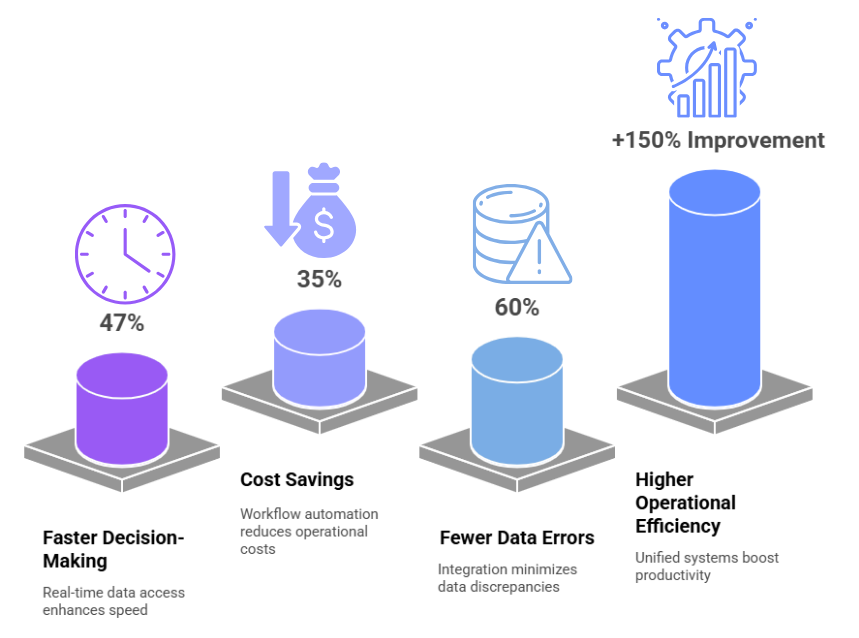
See how cloud integration delivers real, measurable improvements in business performance from decision-making to productivity
Common Use Cases
Cloud integration is applicable across industries and business sizes. Here are a few common scenarios:
E-commerce: Integrating storefronts (like Shopify), inventory systems (like NetSuite), and customer service tools (like Zendesk) ensures real-time stock updates, seamless order fulfillment, and quick resolution of customer queries.
Healthcare: Syncing electronic health records (EHR) with lab systems, scheduling tools, and telehealth platforms ensures physicians access complete, up-to-date patient information, enabling better diagnosis and care delivery.
Financial Services: Linking CRM systems, accounting platforms, and compliance tracking tools allows banks and insurers to automate customer onboarding, generate real-time financial reports, and stay audit-ready.
Education: Universities and schools integrate learning management systems (LMS), student information systems (SIS), and communication platforms to provide streamlined digital learning environments.
Human Resources: Integrating HRIS systems with payroll platforms, benefits management tools, and recruitment software streamlines the entire employee lifecycle from hiring to offboarding.
Marketing and Sales: Integrating tools like HubSpot, Salesforce, and Google Ads enables seamless lead scoring, campaign performance tracking, and faster conversions by maintaining up-to-date contact records.
Manufacturing: Syncing ERP systems with supply chain management and quality control tools helps manufacturers monitor production, track shipments, and reduce downtime with predictive maintenance.
Logistics: Integration between route optimization software, fleet tracking tools, and CRM platforms allows logistics providers to provide accurate delivery times and manage shipments efficiently.
Best Practices for Successful Cloud Integration
To maximize ROI and minimize risk, follow these expert tips:
- Start with clear objectives
Define what you aim to achieve-whether it’s improved reporting, automation, or real-time access. - Choose the right integration platform
Match your complexity and scalability needs with a platform that suits your technical environment. - Standardize data formats and protocols
Use consistent data formats (e.g., JSON, XML) and APIs to reduce friction. - Focus on security and compliance
Make sure your integrations meet industry standards like GDPR, HIPAA, or SOC 2. - Monitor and optimize continuously
Set up real-time monitoring and regularly review performance to spot issues early.
Challenges in Cloud Integration
Despite its advantages, cloud integration comes with challenges:
- – Data security and privacy: Sensitive information must be protected with strong encryption, compliance measures, and access controls.
- – Managing API limitations and versioning: Not all APIs are built equally; maintaining compatibility and performance over time is key.
- – Ensuring real-time performance: Syncing large datasets or time-sensitive processes demands robust infrastructure.
- – Handling vendor lock-in: Relying too heavily on one provider can limit flexibility and increase costs down the road.
- – Technical debt from legacy systems: Older systems may not support modern integration frameworks, complicating transitions.
Partnering with experienced integrators or using robust platforms can help mitigate these risks.
Need expert support for your cloud integration journey?
Enigni offers end-to-end integration solutions tailored to your business needs-helping you connect faster, scale smarter, and innovate with confidence.
Conclusion
Cloud integration is no longer a luxury it’s a strategic imperative for organizations aiming to stay competitive in the digital age. By breaking down data silos, enabling automation, and creating a unified digital ecosystem, integration unlocks efficiency and fuels innovation.
Ultimately, whether you’re starting from scratch or refining an existing setup, success hinges on choosing the right strategy, platform, and execution plan. With the right approach, cloud integration becomes a powerful enabler of growth and agility across your entire organization.
Like what you see? Share with a friend.
Itay Guttman
Co-founder & CEO at Engini.io
With 11 years in SaaS, I've built MillionVerifier and SAAS First. Passionate about SaaS, data, and AI. Let's connect if you share the same drive for success!
Share with your community


.png)
Comments