Low-Code Development Platforms: The Future of Software Building
Low-code development platforms are transforming how organizations build, deploy, and scale digital applications. These platforms provide a visual, model driven environment that enables developers and business users to create software quickly, reducing reliance on traditional hand coding. By combining drag and drop interfaces, prebuilt logic modules, and AI-assisted automation, low-code platforms speed up innovation, lower costs, and bridge the gap between IT and business teams.
What Is a Low-Code Development Platform?
A low-code development platform is a software environment that allows applications to be built through graphical interfaces rather than extensive coding. It enables both technical and non-technical users to design workflows, integrate data sources, and deploy solutions faster.
Core Capabilities:
- – Visual development tools for drag and drop app design.
- – Reusable components to speed up repetitive logic.
- – Workflow automation for process coordination.
- – Data and API integration with enterprise systems.
- – Scalability and management for large organizations.
According to Gartner, by 2026, more than 80% of software applications will involve low-code or no-code development highlighting its shift from trend to standard practice.
Why Businesses Are Adopting Low-Code Platforms
Modern organizations face unprecedented demand for faster software delivery, shorter iteration cycles, and flexible automation. Low-code development platforms address these pressures by:
- – Accelerating speed to market: Build and iterate apps up to 10x faster.
- – Reducing cost: Cut reliance on hard to find engineering resources.
- – Enabling collaboration: Business and IT teams can co-create solutions.
- – Reducing technical debt: Simplify architecture for easier maintenance.
- – Improving agility: Deploy updates seamlessly across cloud and hybrid environments.
These benefits explain why low-code has become the foundation of enterprise digital transformation.
Best Low-Code Development Platforms in 2025
Below is a curated snapshot of the leading low-code platforms shaping the industry in 2025. Each offers distinct strengths depending on scale, complexity, and ecosystem requirements.
| Platform | Best For | Key Features |
| Engini | AI-driven enterprise automation | Native AI Worker integration, real time process coordination, autonomous improvement engine |
| Mendix | Enterprise app delivery | End to end app process, AI-assisted logic, cloud native deployment |
| OutSystems | Enterprise grade scalability | Multi-cloud deployment, DevOps integration, security management |
| Microsoft Power Apps | Microsoft ecosystem integration | Office 365 & Azure compatibility, strong data connectors |
| Appian | Process heavy automation | BPM and workflow orchestration, enterprise analytics |
| Salesforce Platform | CRM centered apps | Lightning App Builder, declarative customization |
| Zoho Creator | SMB and mid market | Affordable pricing, drag and drop simplicity |
| Quickbase | Citizen development | Customizable database-driven apps |
| Budibase | Open source enthusiasts | Self-hosting, developer friendly extensions |
| Retool | Internal tools | Prebuilt components for admin dashboards |
| Appsmith | Developer collaboration | Open source model, Git integration, extensibility |
This blend of enterprise and open source solutions shows the maturity of the low-code ecosystem from accessible SMB tools to enterprise grade digital factories.
Low-Code vs No-Code: What’s the Difference?
While often used interchangeably, low-code and no-code serve different audiences.
| Feature | Low-Code | No-Code |
| Target users | Developers & business users | Non technical users |
| Customization | Allows custom coding | Minimal coding, template driven |
| Use cases | Complex enterprise workflows | Simple apps, forms, automation |
| Scalability | Enterprise level | Departmental or small scale |
Low-code platforms strike a balance providing flexibility for developers while empowering business innovators to participate in solution creation.
The Rise of AI Workers in Low-Code Development
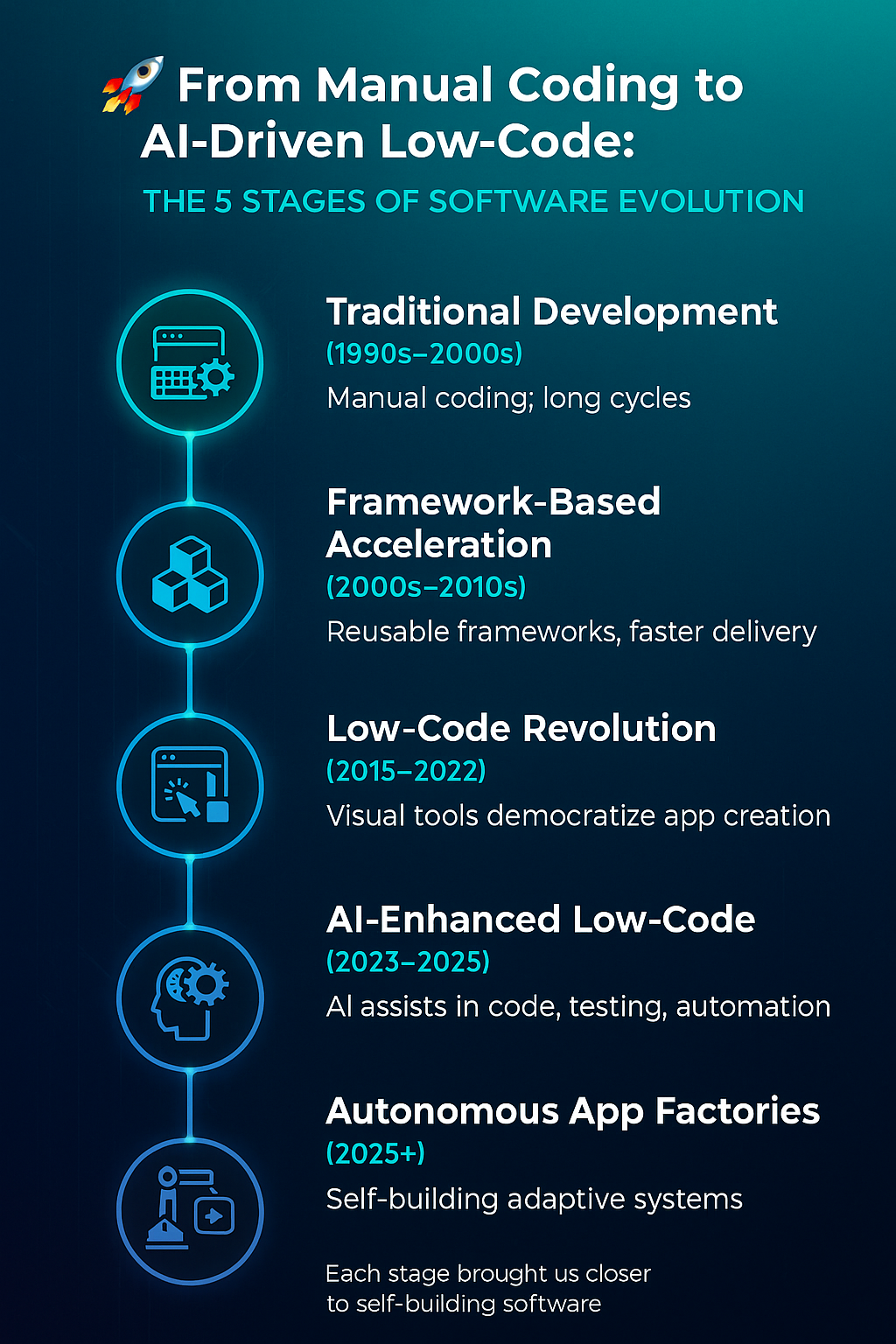
The next evolution of low-code is already underway the integration of AI Workers. These intelligent digital agents operate within low-code environments to automate complex workflows, generate code snippets, and make decisions autonomously.
How AI Workers Enhance Low-Code Platforms:
- – Automate complex processes: Handle multi step workflows with logic and data analysis.
- – Boost productivity: Suggest improvements and generate data models instantly.
- – Learn and adapt: Improve over time through machine learning feedback.
- – Enable collaboration: Work seamlessly alongside human developers and business users.
Together, low-code and AI Workers redefine business agility enabling continuous innovation with less human intervention.
Real-World Use Cases
1. Customer Service Automation
AI-powered low-code processes help manage tickets, fix common issues, and improve response speed. As a result, customer support becomes faster and more consistent.
2. Operations Improvements
Supply chain teams use visual reports to monitor performance, while AI Workers predict delays and suggest preventive steps. This way, teams can act early and reduce downtime.
3. Data-Driven Decision Support
AI Workers study company data in real time and highlight insights for leaders through simple dashboards. Therefore, decision-making becomes faster and more accurate.
4. SaaS Product Innovation
Teams can create, test, and release modules faster with AI-guided automation cycles. Moreover, they can experiment and improve features without heavy coding.
5. HR and Onboarding Automation
Smarter screening and hiring tools simplify candidate review and speed up onboarding by up to 80%. In turn, HR teams save time and focus on people instead of paperwork.
How to Choose the Right Low-Code Development Platform
When evaluating low-code solutions, consider these key criteria:
- – AI Integration: Does it include native automation or rely on external tools?
- – Ease of Collaboration: Can business and technical teams co-develop?
- – Security & Compliance: Does it meet enterprise grade management standards?
- – Deployment Flexibility: Cloud, hybrid, or on-premise options available?
- – Scalability: Can it handle complex enterprise workflows?
Organizations should pilot at least two platforms to evaluate scalability, integration ease, and total cost of ownership before committing.
The Future of Low-Code: Human Creativity Meets Machine Intelligence
As enterprises digitize every function, low-code platforms are evolving into coordination layers that connect human innovation with AI-powered execution. The convergence of low-code development and AI Workers represents a new paradigm: applications that build, optimize, and evolve themselves.
Businesses that adopt this fusion early will outpace competitors building smarter, scaling faster, and reducing development friction across teams.
Conclusion
Low-code development platforms are no longer just tools for building apps quickly. They are now a key part of digital change, helping both technical and business teams work together and create new ideas faster.
The rise of AI Workers takes this progress even further. Together, low-code and AI speed up development and help systems learn, improve, and adjust to business needs on their own. This shift turns software from a one-time product into a system that keeps getting better over time.
As the industry grows, platforms like Engini lead the way by bringing together easy-to-use low-code tools with smart, AI-powered features. This combination allows teams to build, launch, and grow digital solutions faster making technology more accessible and innovation more constant.
FAQs
1. What is a low-code development platform?
A low-code platform lets users build applications visually, using simple drag-and-drop tools.
This approach reduces the need for traditional programming and makes app creation faster and easier.
2. How is low-code different from no-code?
Low-code gives developers room to add custom logic, while no-code focuses on ready-made templates
for non-technical users. In short, low-code offers flexibility, and no-code focuses on simplicity.
3. What are the best low-code platforms in 2025?
The leading options include Engini, Mendix, OutSystems, Microsoft Power Apps, Appian, Salesforce,
Zoho Creator, Quickbase, Budibase, Retool, and Appsmith. Each serves different business needs.
4. How do AI Workers enhance low-code development?
AI Workers automate complex tasks, improve code quality, and make decisions based on real-time data.
As a result, they increase efficiency and scalability.
5. Are low-code platforms secure for enterprise use?
Yes. Most low-code platforms include access controls, audit trails, and compliance tools that protect
company data. Therefore, they are safe for enterprise environments.
6. Can low-code integrate with existing enterprise systems?
Absolutely. Most tools come with built-in connectors for ERP, CRM, and cloud services.
This means integration is quick and seamless.
7. Will low-code replace traditional coding?
Not entirely. Low-code works alongside traditional development by handling repetitive or
process-heavy parts. Meanwhile, developers can focus on advanced logic and design.
8. How should a company choose between vendors?
Start by comparing scalability, integrations, and pricing. Then, test one or two shortlisted
platforms before making a full investment.
Like what you see? Share with a friend.
Itay Guttman
Co-founder & CEO at Engini.io
With 11 years in SaaS, I've built MillionVerifier and SAAS First. Passionate about SaaS, data, and AI. Let's connect if you share the same drive for success!
Share with your community


.png)
Comments